Friday, February 10, 2012

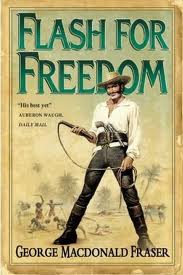
Flash for Freedom - Chapter 8


Flashman believed that the two men who approached him at the end of Chapter 7 were apprehending him on behalf of the navy. They are actually far from that. He's hooded and taken with them who knows where.

When the hood is removed he finds himself in a well furnished and appointed room facing a rather innocuous looking fellow. As the man begins to talk and outline what he wants Flashman to do and why, Harry knows he's in the presence of another fanatic like Bismarck. Flashman seems to have a knack for finding these types, it's rare for a book to go by without at least one of them appearing, they usually get Harry into all sorts of trouble, almost as much as his pursuit of women does.

This one goes by the name of Crixus, exactly who he really is, is never discovered, and he may have been a composite of a number of prominent abolitionists, I don't believe George MacDonald Fraser ever really speculates on his identity, even in the notes. Crixus is an abolitionist, part of a movement that was devoted to getting rid of the institution of slavery in the US. John Brown is one of their best known members, and his involvement with Harry Flashman is covered in another book (Flashman and the Angel of the Lord), I wonder if the seeds for that packet were sewn when Fraser was writing this one.

Crixus believes Harry is the anti slavery British naval lieutenant Beauchamp Comber and will jump at the chance to undertake the task they have him earmarked for. He is supposed to help them smuggle an escaped slave by the name of George Randolph out of the south and into the slave free north. By the time I read Flash for Freedom I had learned about Dred Scott and his famous case. Randolph is possibly in part based on Scott.

George Randolph is the sort of person Harry detests, irrespective of the colour of his skin, he's arrogant, vain and pompous. He's quite intelligent, but not especially worldly or street smart. From the time he opens his mouth he rubs Harry up the wrong way. Flashman can't refuse Crixus, he may look like a cheerful old buffer, but he's not where his cause is concerned. Flashman has met enough of his sort to know that if he knocks him back then his life will become a living hell, that's if Crixus even allows him to get out of the room alive. With no other option open to him Flashman agrees to do what they ask. At least with him being white and Randolph being black they won't have to travel together.

You'll Be Sorry When I'm Dead by Marieke Hardy


I first became aware of Marieke Hardy when someone alerted me to one of her regular columns in the The Age newspaper's weekly TV Guide The Green Guide. I think the first column of hers I read dealt with TV chef Nigella Lawson and Marieke's undying love for her and her bounteous breasts. I became a religious reader of Ms Hardy's column from that point on, they were screamingly funny and a highlight of the paper, it was a sad day when she left The Green Guide to pursue her other career in script writing for TV.

Marieke Hardy comes from a relatively famous Melbourne media family. Her great aunt was Mary Hardy, a popular radio and TV hostess in the 1970's, and her grandfather was journalist Frank Hardy, best known for his best selling novel Power Without Glory that was a fairly thinly veiled and largely true story of the tumultuous life and career of political power broker John Wren (he was called West in the book). Like her grandfather, and even her father, Marieke writes for a living. She's written a fair bit for papers and her own blogs, these days she spends most of her time working on TV scripts, she's had stints working for the perennial soap Neighbours and the runaway success Packed to the Rafters, she's also written for two shows of her own making; Last Man Standing and Laid.

As far as I know You'll Be Sorry When I'm Dead is her first book, and if it's anything to go on she's got a long career writing books ahead of her, fictional or not. Despite being in her mid thirties Marieke seems to have packed more than one lifetime of living into those 30 + years.

There are accounts of her experimentation with prostitutes and 'swinging', her encounter with a childhood idol and one of her adulthood as well, her experience as an accidental stepmother, the moving account of one of her best friend's ongoing battle with cancer and travels with and without her parents. The Fitzroy Football Club even cracks it for a mention. Marieke still seems to bare the scars of the AFL's murder of that once proud club. I'm not and never have been a Fitzroy follower, but it still irks me what the AFL did there.

When I read Barry Humphries' 'biography' of his alter ego Edna Everage I spoke about how he had really observed and written so well about the Melbourne of his early adulthood back in the 50's. Marieke does the same thing for life in inner city Melbourne in the 90's and 00's. I've known people like her friends, I can see the places she talks about, mainly because I know most of them, not as intimately as she does, but I am familiar with them. It's marvelous writing and captures the feel of where she is and what she's doing.

You'll Be Sorry When I'm Dead is by turns devastatingly honest, painfully accurate, deeply moving and most often of all hysterically funny. I wouldn't recommend reading it on public transport, people tend to look at you when you're breathless with laughter and have tears streaming down your face and most of them don't believe you when you hold up a book by way of explanation. That public humiliation aside I'd heartily recommend You'll Be Sorry When I'm Dead. As another great Australian writer; Cj Dennis, would have said 'I dips me lid.'.

Wednesday, February 8, 2012

Flash for Freedom - Chapter 7


After a couple of fairly lack lustre chapters which I felt kind of trod water, and I’m convinced Chapter 6 only existed to introduce Abraham Lincoln into the narrative things pick up in Chapter 7, the narrative starts to move again and a new character is introduced, one of my favourites actually.

Although Harry thought Baltimore would be the ideal place to head for home I think New Orleans, or ‘Awlins as the locals call it, is better. As soon as his navy escort takes their eyes off him he simply melts into the crowd, and in New Orleans in the 1840’s a crowd was a very easy thing to disappear into. Flashman confesses to liking the port town. He rates it in his top 3, after London, which is his home, and Calcutta, which is his home away from home. I’ve been to New Orleans and I can see the appeal for someone like Flashman, wonderful town, lively, exotic place with an exciting history.

The first thing Flashman does he alter his appearance subtly. He’s grown a beard during his time at sea, so he has that removed, although he keeps his ‘tart catchers’ (those are his magnificent moustache or cavalry whiskers), and I love that name. Makes me giggle every time I read it. He also outfits himself impressively in a very European style and he even goes far enough to order some calling cards made in the name of Count Rudi von Starnberg, again a laugh out loud moment. It amuses Harry to think that somewhere down the track Rudi may get stuck with the bill for a stack of calling cards. Unlike many of Flashman’s innocent victims Rudi is a murderous, black hearted bastard, who deserves that and more. It also struck me here that Flashman isn’t great at coming up with aliases. He does the character well, just not the name. So far readers have seen him use people they’re already acquainted with. Thomas Arnold in Royal Flash and now Rudi. It’s kind of interesting, because he’s an accomplished liar, a large part of his life is a lie and he carries that off with style, but he can’t think up plausible sounding names. He basically sets himself up as an Austrian nobleman.

A large part of his resources have been used in altering his appearance and outfitting himself, he’ll need most of the rest to get passage back to England. He also doesn’t want to stay at a hotel, it would be the first place to look. He remembers the words of Italian soldier of fortune Avitabile, who he met in Flashman. If you find yourself short of funds in a city and need a place to stay for a bit, find a bawdy house and romance the madam. In New Orleans at the time, you would find it harder to find a normal house than a bordello. Flashman has concocted some wild story about a missing sister to get himself entrance and introduction to the madams. He discards the first few because he doesn’t much like the look of the ladies running the place until he lobs at Susie Willincks. Susie is from England, Flashman describes her broad accent as pure Bow Bells, which immediately aids Harry’s cause. Although she’s well past her prime and is fighting a losing battle with her weight, Susie is still a handsome woman and must have a beauty when younger. She takes to Flashman immediately, although she sees through his Austrian nobleman disguise, she does accept that he’s a British naval lieutenant called Comber.

Despite what she does for a living, and presumably always has, Susie is a bit of a soft touch. She’s a nice lady and has genuine feelings for Flashman, although she never finds out his real name, only knowing him as Lieutenant Beauchamp Millward Comber. Flashman has a soft spot for her too, but as is the case with many of his partners, she’s a means to an end, and sure enough as soon as he thinks he can he leaves the bordello and doesn’t look backwards. Next to Elspeth, Susie is my favourite of the never ending parade of women that float in and out of Harry’s life and adventures. Flashman thinks he’s home free, just get to the docks and the ship he’s arranged passage and off he goes. He never makes it that far. He’s accosted by two armed men who don’t seem inclined to listen to him. Just what has he walked into now?

Neverwhere by Neil Gaiman


I've never actually read a Neil Gaiman novel before. I've read the first Sandman collection and Good Omens, there was also a poem in Welcome to Bordertown, but Sandman is a graphic novel and Good Omens was co written with Terry Pratchett, so I was looking forward to the opportunity the list provided me with to check out one of fantasy's hottest properties.

Neverwhere started life as a TV programme, although Gaiman himself said that every time they made him cut something from the programme he said he'd include it in the book. Neverwhere is Neil Gaiman's first actual novel, Good Omens came out some years earlier, but as pointed out above that was a co authored project.

It's the story of Richard Mayhew, an unremarkable young man, who stops to help an injured girl en route to a dinner with his pretty, but shallow and unpleasant fiancee; Jessica, and her powerful media mogul boss, and finds himself rubbing shoulders with all sorts of unusual types in the world of London Below (the Neverwhere of the title), while avoiding Messrs Croup and Vandemar; a team of assassins, who delight in inflicting pain.

Whilst in London Below Richard encounters all sorts of oddities. The creatures who lend their names to places he knows in London Above, the blacksmith who goes by the name of Hammersmith, the shadowy information trader Old Bailey and the Angel called Islington.

Richard is an interesting hero, mainly because he's not particularly heroic. He's not physically imposing, he goes about his daily business efficiently, but quietly, he shies away from any sort of conflict and he's easily rail roaded into things, he doesn't even particularly like Jessica, but he's going to marry her, simply because he doesn't know how to get out of the relationship, which he seemed to fall into by accident. He does however have heroic qualities about him. He's compassionate, he assists Door even though he doesn't have to and he knows it will cause problems with Jessica. He's brave, he hides Door from Croup and Vandemar even though they scare him and he knows that they can physically hurt him. He's loyal, he's the one who takes over when Hunter betrays her companions and him.

The setting was extraordinary although the language Gaiman used wasn't particularly remarkable, this may have been because the novel was essentially an adaptation of a TV show and the initial script relied upon the visual medium to convey to the watcher what they were seeing. London Below is at once strange, dark and dreamlike. There are elements of Alice's Adventures in Wonderland in Neverwhere, although it is darker than Lewis Carroll's work. Neil Gaiman may have a particular affinity with that classic, there is a scene in Sandman that shows a bookcase filled with books that were never written and one of those is a continuation of young Alice's adventures.

Once out of London Below and living his quiet life in London Above, although significantly improved from the one he left, Richard wants to go back to the world where rats talk and you meet mythical creatures at the Floating Market. He does find the world he left behind and the book closes with Richard returning to London Below.

Neil Gaiman hasn't written a sequel to any of his work, but he has occasionally considered returning to the Neverwhere concept. Things have been written, but not completed and it remains to be seen if a new installment will ever appear, it was left open ended enough that this is a possibility if the author ever wants to do so.

It shares similarities with a number of other hidden world type stories, the darkness recalls Clive Barker's Weaveworld, and Simon Green's Nightside series (beginning with Something From The Nightside) set in a hidden London, I read the first one of these and wasn't greatly impressed. I also kept flashing on Catherynne M. Valente's Hugo nominated work Palimpsest and can highly recommend that if for no other reason that an opportunity to read Ms Valente's amazing prose.

Flash for Freedom - Chapter 6


In Chapter 6 of Flash for Freedom, our anti hero has appropriated the identity of dead naval lieutenant Beauchamp Comber and convinced the American authorities that he was in fact trying to put an end to John Charity Spring's nefarious trade, not assist it. Having been shot in the back by Looney, JC Spring isn't in a position to argue or denounce Flashman. The documents Harry had sewn into his belt only help to prove the truth of his story.

Once in the US, Harry has to scheme how to get out again, and back to England. The last thing he wants to do is testify against Spring. There are two issues at stake for him. Unfortunately Looney didn't kill the pyschotic former scholar, so therefore Flashman is still a little afraid of what might happen to him if he testifies and has Spring convicted. Secondly Spring can quite possibly prove that Flashman isn't Comber, he may be able to get out of any charges, because he wasn't a registered crew member, being taken on as a supercargo, but the resulting fall out would ruin him back home.

He seems to be carrying his deception off quite successfully until he meets an interesting chap at a dinner party. He is described thus: 'He was an unusually tall man, with the ugliest face you ever saw, deep dark eye sockets and a chin like a coffin, and a black cow's lick of hair smeared across his forehead.' Now if that description hasn't given it away the man Flashman is referring to is Abraham Lincoln, at this stage he was not President, but serving his one and only term as a Congressman. George MacDonald Fraser was not only unflattering in his physical description of the revered President, he was equally blunt in his assessment via Flashman of the man's politics and character. Fraser's Lincoln is a practical man, blunt in his speech and forthright with his opinions. In fact Flashman believes they are both rogues, they just go about things differently.

Abraham Lincoln is one of the few men who sees right through Flashman, and knows he isn't a naval lieutenant. He also believes that he's not as honourable or as innocent as he would like people to believe, although later actions in this and other books indicate that he had fallen for the hero myth that Harry creates for himself. It suits Lincoln's purposes to not expose Flashman as a fraud, he's still needed to testify against Spring.

There's two places where Flashman may end up; Baltimore or New Orleans. He'd prefer Baltimore as he feels he can get away easier from that port, but he's required at New Orleans, so that's where he's shipped off to and where he plans his escape from.

Tuesday, February 7, 2012

Flash for Freedom - Chapter 5


Chapter 5 is by far the shortest so far, although it still has a lot happening in it. They unload their cargo and take on a number of mixed breed girls, destined for New Orleans bordellos. Flashman is allowed to keep Lady Caroline Lamb, because Spring believes that if Harry can teach her English then she'll be valuable as an interpreter.

Once again the Balliol College is pursued by American Navy ships. This time there is more than one and they're far more determined and better armed than the one off the coast of West Africa.

Despite being a good captain Spring isn't certain he can throw these ones off and is determined that he won't be caught with slaves aboard. He orders his men to connect the girls to a length of chain and throw them overboard if it looks like they're going to be caught. If there's no evidence of slaves on the boat they can't be prosecuted. Even Flashman is horrified at this level of callousness, although the notes do mention that worse had been done in reality. Spring's first mate also argues this with him.

Flashman has a plan, but it won't work if Spring tosses the girls overboard. The only person aboard who had ever really shown Looney anything approaching decent treatment was Sullivan (Spring's first mate). Harry points out the argument to Looney, and tells the poor man that Spring is going to kill him if someone doesn't stop the psychotic captain. This for once isn't the case, but poor Looney swallows it and goes after JC Spring.

The actions allow the American's to catch up to the slaver and Flashman immediately begins to act like an officer in charge. He's definitely got something in mind. Devious chap that he is.

Sunday, February 5, 2012

Flash for Freedom - Chapter 4


After ALL of the action in Chapter 3, Chapter 4 is a bit of a come down. A lot of it concerns itself with the business of preparing, loading and then transporting the cargo of the Balliol College. I guess at the time Flash for Freedom came out, the finer details of slave trading didn’t exist outside of non fiction. By the time I read it, I’d seen TV programs featuring it and read a number of books, including an excellent children’s book the name of which escapes me (it may have been Slave Dancer) that dealt with the same subject, so it was a bit old hat for me and not of much interest. I was struck this time by how Flashman describes these situations, but does so in a totally self centred way. It’s never about the ordeal others are going through, more about how it affects him personally.

Once underway there’s a rather half hearted chase by an American ship, they also tally up the ‘butchers bill’ and it’s worked out that, not including the cabin boy, they lost 5 men in the engagement on the beach. No one believes Comber will survive either, if for no other reason than Mrs Spring has volunteered to nurse him.

The men are encouraged to avail themselves of the female slaves, apparently if it can be proved that they’re ‘breeders’ it increases their value on the block. Flashman adopts one young lady, and unable to learn her language, teaches her both an English phrase and a Latin one, he does the latin to annoy John Charity Spring, he also christens her Lady Caroline Lamb, because it amuses him. The real Caroline Lamb was an aristocrat and novelist who had an affair with Byron, she died in 1828, so I’m not really sure why Flashman gave the girl that name unless his family was somehow connected to the woman. Maybe Buck had an affair with her, as well.

There is an incident involving Charity Spring that is going to have ramifications for the story later on. The ship has a mentally disabled cabin boy and general dogsbody they name Looney. The rest of the crew generally make fun of him or use him as a punching bag. Charity Spring as he tends to do takes it too far, and it alters the boy’s personality.

Comber dies of his wounds, but before doing so asks to see Flashman and makes a deathbed confession. He’s not a sailor who signed on with a slaver because of some scandal. He’s actually a British naval lieutenant collecting information with the intention of prosecuting all involved. When he realises he’s going to die he pegs Flashman as the person who can continue his work. Flashman comes into possession of the documents that not only can sink John Charity Spring, but also point to John Morrison as profiting from slavery. Flashman hides the paperwork by sewing it into his belt, but determines that it will make for an excellent way of squeezing his father-in-law when he gets back to England.

The Balliol College arrives to a chaotic scene in a Cuban port, because gold has just been discovered in California and everyone and their dog is off to stake a claim.